For the past couple of years, the conversation around Microsoft Copilot has largely focused on adoption: who should have a licence, where Copilot can save time, and how organisations encourage employees to use it effectively.
That conversation is now evolving.
As Microsoft expands Copilot beyond individual prompts and into agents, Copilot Studio and more autonomous experiences such as Copilot Cowork, organisations increasingly need to think about consumption as well as licences.
This matters because the next phase of AI adoption will not simply be about giving people access to Copilot. It will be about deciding which AI capabilities are worth consuming, who should have access to them, how they are governed and whether they are delivering measurable value.
That makes Copilot consumption much more than a licensing issue.
From AI assistant to AI workforce
The easiest way to understand the shift is to look at what AI is being asked to do.
The first generation of Copilot use cases were relatively straightforward. Summarise this document. Draft an email. Recap this meeting. Help create a presentation.
Increasingly, AI is being asked to do something different.
Instead of:
“Help me complete this task.”
The request becomes:
“Complete this outcome for me.”
That may involve retrieving information from several sources, reasoning across it, using different tools and completing multiple steps before returning a result.
This is an important distinction.
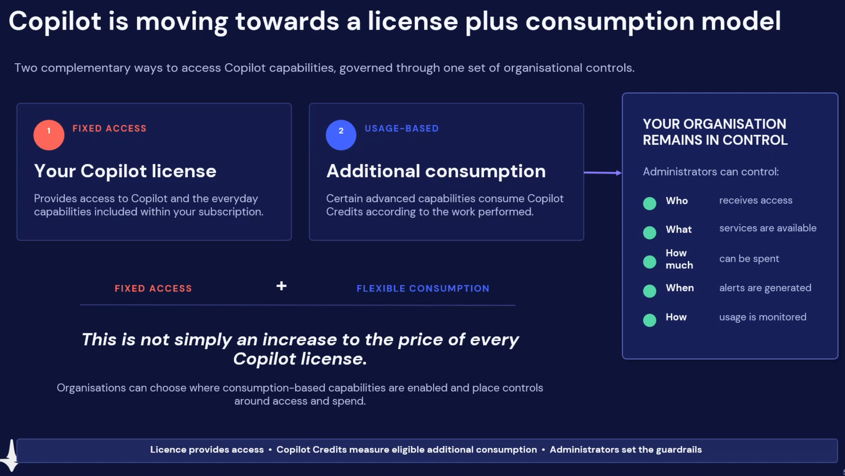
As AI moves from assistance towards delegated work, the amount of computing, orchestration and reasoning involved can vary significantly from one task to another. Microsoft's commercial model increasingly reflects that through consumption-based services measured using Copilot credits.
So organisations need to understand two complementary concepts:
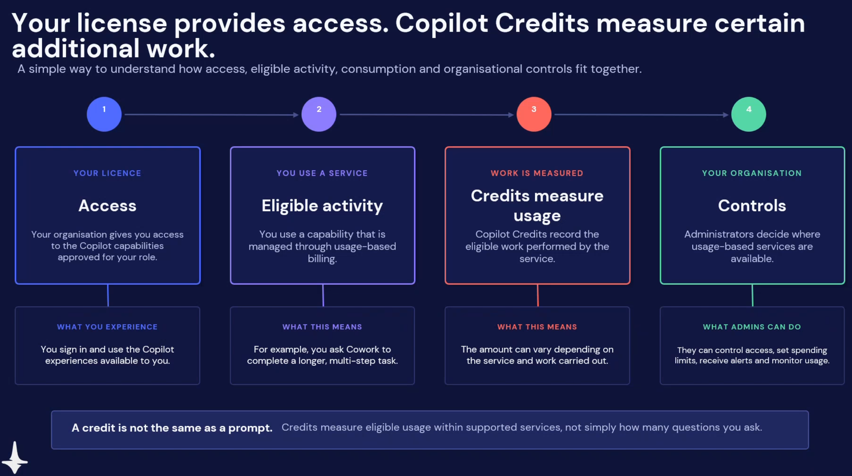
Licensing provides access. Consumption measures eligible additional work.
And crucially, a Copilot credit is not simply another name for a prompt.
Two requests can require very different levels of processing. A straightforward request to summarise a document is fundamentally different from asking AI to gather information, analyse it, create an output and coordinate a longer sequence of work.
Not every Copilot prompt is suddenly chargeable
This is one of the most important misconceptions to address.
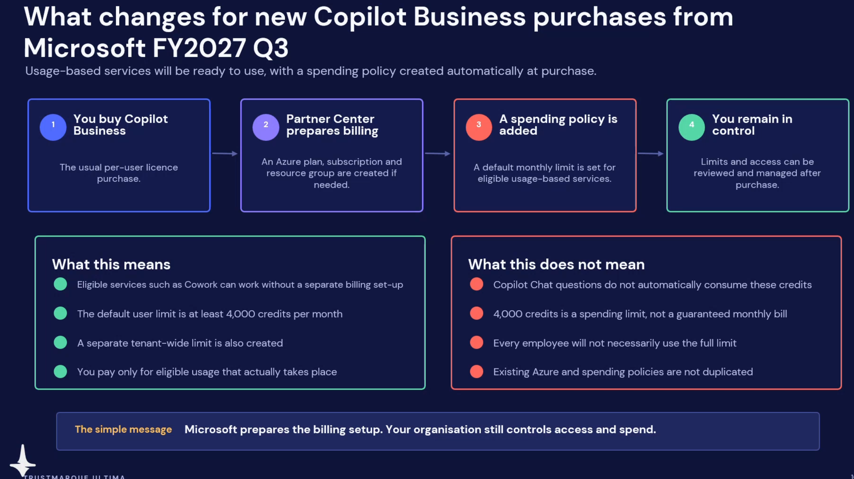
Consumption-based AI does not mean that employees should hesitate before every prompt because they are worried about generating another charge.
Everyday capabilities included within the relevant Microsoft 365 Copilot licence remain part of that licensed experience.
Consumption becomes relevant where organisations start using eligible usage-based services and more advanced experiences.
That distinction is important for adoption.
If organisations communicate the change poorly, there is a real risk of creating a culture where employees become afraid to experiment with AI because they believe every interaction is costing money.
The better conversation is about using the right AI capability for the right job.
Sometimes ordinary Microsoft 365 Copilot will be entirely sufficient. In other situations, an agent or a more autonomous capability may generate significantly greater value.
The question should therefore move from “How much does AI cost?” towards “Is the value of this AI task greater than the cost of completing it?”
That is a much more useful business conversation.
Copilot governance can no longer belong to IT alone
Consumption also changes who needs to be involved.
Historically, technology licensing could often sit predominantly between procurement, IT and finance. AI introduces more interconnected decisions.
IT needs to manage the technical environment, access and policies.
Finance and procurement need visibility of consumption, budgets and how variable AI costs are being managed.
Security and compliance teams need to understand what new capabilities can access and whether their use aligns with organisational policies.
Business leaders need to identify the processes where AI can create genuine value.
Adoption and change teams need to make sure employees understand which capabilities to use, when to use them and how to work with them effectively.
That shared ownership becomes even more important as AI develops further.
An organisation may technically be capable of deploying an AI capability, but that doesn't automatically make deploying it widely the right decision.
The starting point should always be the business outcome.
The biggest risk isn't consumption. It's uncontrolled consumption.
Consumption-based technology isn't inherently something organisations should fear.
Cloud computing has operated on similar principles for years. Organisations routinely manage Azure consumption by controlling access, monitoring usage, setting budgets and optimising workloads.
AI now requires a similar discipline.
The danger is not that somebody uses Copilot Cowork or an agent.
The danger is enabling advanced AI capabilities across an organisation without understanding who is using them, why they are using them, what they are consuming and what value is being generated in return.
This is where guardrails become essential.
Organisations can think about different policies for different groups rather than treating the entire workforce identically.
A team using AI to automate complex, high-value workflows may justify significantly more consumption than an employee whose requirements are adequately covered by standard Copilot capabilities.
The objective shouldn't be to minimise consumption at all costs.
It should be to make consumption intentional.
Start constrained, then earn the right to scale
There is a temptation with AI to enable everything and work out governance afterwards.
The smarter approach is the opposite.
Start with tighter controls. Identify the people and use cases most likely to generate measurable value. Monitor what happens. Then expand access based on evidence.
That might mean beginning with a defined group of users, setting appropriate policies and monitoring their consumption against outcomes.
For each use case, organisations should be able to answer:
- What business problem are we solving?
- Which Copilot capability is actually required?
- Who genuinely needs access?
- What will the AI activity cost?
- What employee time or operational cost will it replace?
- What security and data controls need to apply?
- How will we know whether it has delivered value?
If those questions cannot be answered, scaling the technology is premature.
Cost visibility will become part of AI literacy
We often talk about AI literacy in terms of prompting.
That definition now needs to expand.
Employees don't necessarily need to become experts in Microsoft's commercial model, but they should understand that different AI capabilities can consume resources differently.
Someone who can achieve an outcome efficiently using their existing Copilot capabilities shouldn't automatically reach for a more sophisticated autonomous workflow.
Equally, businesses shouldn't avoid a consumption-based capability simply because it has an additional cost. If an agent can remove hours of repetitive work from a high-value process, additional consumption may be commercially insignificant compared with the productivity gained.
Good AI literacy therefore means understanding capability, risk, cost and value together.
Five questions organisations should be asking now
Rather than waiting until consumption grows, organisations should use this period to establish their approach.
1. What Copilot capabilities are already being used?
Understand your existing licences, adoption and billing arrangements before adding more complexity.
2. Which users actually need advanced capabilities?
Use personas and real business scenarios rather than enabling additional functionality uniformly.
3. What controls should be in place?
Determine access policies, spending limits, security requirements and ownership before wider deployment.
4. How will consumption be monitored?
Visibility needs to exist before scale. AI consumption should become part of regular technology and financial management rather than appearing unexpectedly at the end of a billing period.
5. What constitutes value?
Consumption on its own tells you very little.
Organisations need to connect spend to an outcome, whether that's hours saved, faster customer response, reduced manual administration, improved employee experience or an entirely redesigned business process.
The organisations that win won't necessarily consume the least
Perhaps the most important point is that optimisation should not become a race to drive AI consumption towards zero.
An organisation spending very little on AI but generating no meaningful transformation hasn't necessarily succeeded.
Likewise, higher consumption isn't automatically a sign of effective adoption.
The organisations that get this right will understand where additional AI consumption creates disproportionate business value and will deliberately invest there.
They will know where standard Copilot is sufficient, where an agent makes sense and where more autonomous AI can materially change the economics of a process.
That is a more mature definition of AI adoption.
It moves the conversation beyond licences and prompts towards outcomes, operating models and return on investment.
Prepare before you scale
The arrival of more consumption-based AI shouldn't stop organisations from exploring Copilot. If anything, it should encourage them to become more deliberate about how they do it.
Start by understanding your current position.
Review your licensing and billing arrangements. Map your users and priority use cases. Define ownership across IT, finance, security and the business. Establish guardrails. Put monitoring in place.
Then experiment in controlled areas where the potential value is clear.
Because the question facing organisations is no longer simply:
“Should we give our people Copilot?”
It is increasingly:
“Which work should we allow AI to perform, what is that work worth to us, and how do we scale it responsibly?”
That is the conversation organisations need to be having before the next phase of Copilot adoption begins.
How ready is your organisation for Copilot consumption?
As Copilot moves towards a combination of licensed and consumption-based capabilities, understanding your current position is a useful first step. Trustmarque Ultima's Copilot Credit Readiness Assessment uses 15 questions to assess areas including licensing, user readiness, technical guardrails and governance, producing a personalised readiness report to highlight where to focus next.
Take the free Copilot Credit Readiness Assessment and understand where your organisation needs to act before scaling AI consumption.